
Before you start
- Water-soluble extractives in western redcedar can discolor paint.
- Cedar left bare for 16 weeks before painting peeled within 3 years in federal tests.
- Paint: about 10 to 20 years; semitransparent stain: about 4 to 8 years.
Cedar is the classic Northwest siding: light, stable and naturally decay-resistant in its heartwood. It also has a reputation for being tricky to paint. The U.S. Forest Products Laboratory’s Wood Handbook explains why, and what to do about it.
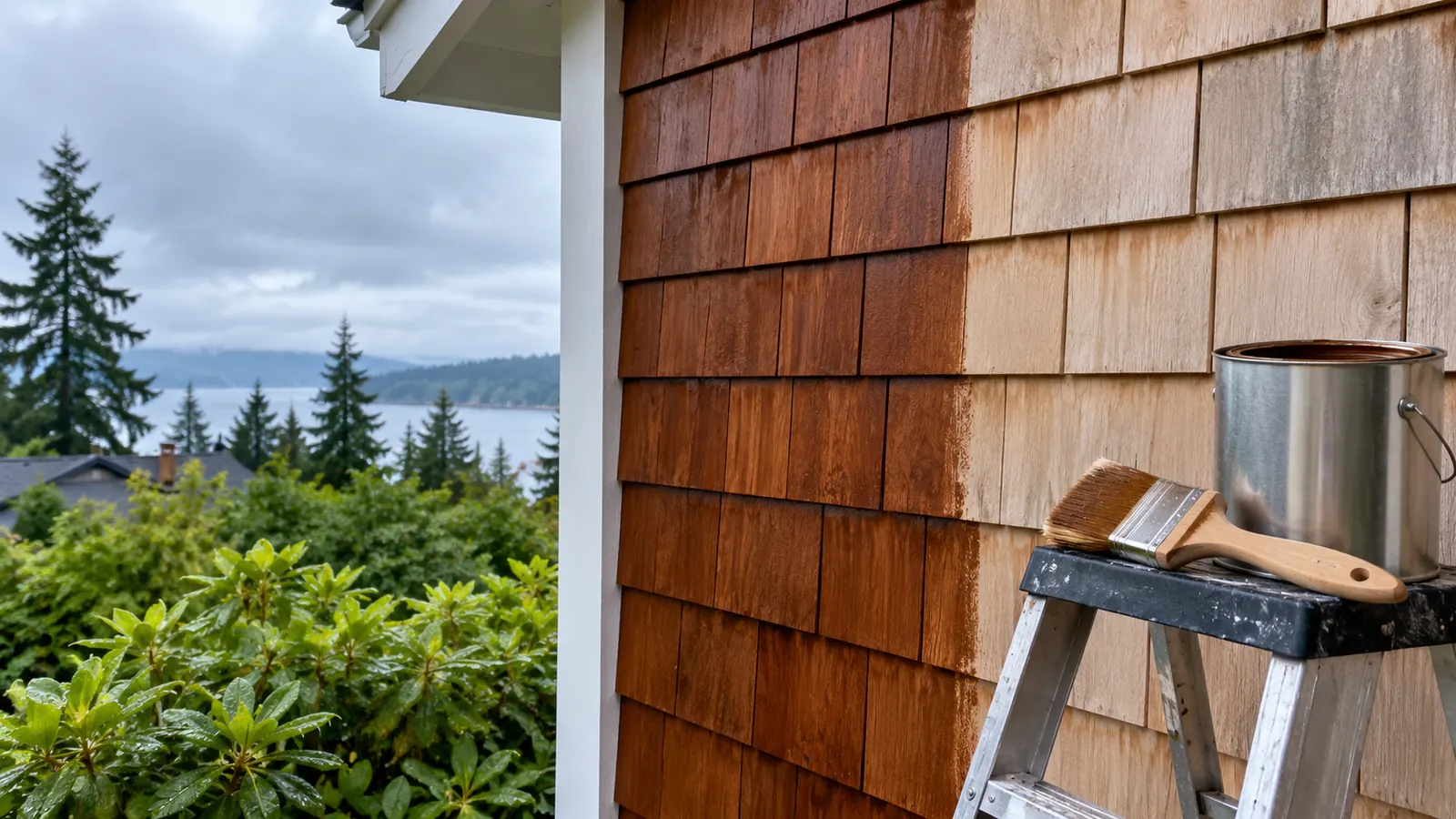
Why cedar stains paint
The heartwood of western redcedar, like redwood, contains highly colored extractives, many of them soluble in water. The Wood Handbook warns that these water-soluble extractives can discolor paint. When rain or dew gets through a thin coat or into open joints, it dissolves the extractives and carries them to the surface as stains, which show most on light colors.
The fix: stain-blocking primer
The handbook recommends a stain-blocking primer on woods with extractives and notes that back-priming with stain-blocking primer helps stop extractives from running down the face of the siding. It advises letting a latex stain-blocking primer dry for at least 24 to 48 hours before the first top-coat, then applying two top-coats.
Tip: If stains appear after painting, look for where water is getting in, such as an open joint or unsealed board end, before simply painting over them.
Do not leave cedar bare
One of the handbook’s clearest results comes from tests on planed, all-heartwood, vertical-grain western redcedar. Boards left outdoors for 16 weeks before painting peeled within 3 years. Boards left out only 1 week peeled after 13 years. Boards painted without any weathering showed no peeling after 20 years. For low-density species such as cedar, the handbook advises finishing as soon as possible after installation, or better, priming before installation.
| Weeks bare before painting | Result in Forest Products Laboratory tests |
|---|---|
| 0 | No peeling after 20 years |
| 1 | Peeling after 13 years |
| 16 | Peeling within 3 years |
Back-priming and end grain
Back-priming means coating the back of siding before it goes up. Along with sealing the cut ends, it slows water absorption from behind and from the ends. The handbook recommends sealing end grain with an oil-alkyd primer at the same time. On an existing house, focus on the ends you can reach: butt joints, board ends at corners and where siding meets trim or roof.
Paint, solid stain or semitransparent stain?
| Finish | Look | Service life on siding |
|---|---|---|
| Paint (primer plus two top-coats) | Opaque, any color, can be glossy | About 10 to 20 years |
| Solid-color stain (primer plus two top-coats) | Opaque, flat, shows texture | About 6 to 15 years |
| Semitransparent stain | Grain and texture visible | About 4 to 8 years on saw-textured or weathered wood |
Semitransparent stains penetrate rather than form a film, so they seldom crack or peel and recoating needs little prep, but they need renewing more often. The handbook also notes that finishes adhere better and last longer on saw-textured cedar than on smooth-planed boards.
Vertical grain and flat grain
The highest grade of western redcedar bevel siding is vertical-grain and all heartwood, according to the handbook. Flat-grain cedar finishes much like other low-density woods. Either way, the extractives are in the heartwood, so the primer step matters on any cedar you plan to paint a light color.
Cleaning cedar
Cedar grows mildew like any wood in a damp climate. Clean it with the dilute bleach and powdered detergent method before refinishing, and keep rinse water pointed down so it does not soak in behind the boards. Details are in Mildew, Algae and Moss: How to Clean Siding Before You Paint in the Northwest.
Knots and pitch
Cedar knots bring their own problem. The Wood Handbook explains that knots contain resins and colored compounds that can make paint peel or turn brown, and that some of these extractives dissolve in oil-based primers and pass through them, while latex formulations do not block them either. The handbook’s remedy is to coat knots with shellac or a specially formulated knot sealer, never varnish, and then apply primer and two top-coats.
Water blisters on cedar
Blisters that appear soon after painting usually mean water in the wood. The handbook describes water blisters forming between the wood and the first coat, most often when oil-alkyd paint goes onto wet wood or when rain enters through poorly flashed doors, windows and vents. They are uncommon with latex paint systems. Keeping water out of the wood is the only way to prevent them.
Whichever finish you choose, keep notes on the product, color and date. Cedar is a long-lived siding, and knowing exactly what is on the wall makes the next refinish faster and avoids putting an incompatible product over the old one. The handbook notes, for example, that latex top-coats can go over oil-alkyd primers, so it helps to know what is underneath.
For timing a cedar job, see The Best Time to Paint a House in Everett: Reading the Calendar and the Siding, and for the full sequence, Exterior Paint Prep Checklist for Everett Homes: From Washing to the Last Coat.
How long will your paint or stain last? Try the paint life check.