
Before you start
- July and August average under 1 inch of rain at Paine Field, with about 2.5 rainy days each.
- Paint wood when its moisture content is near 12%; above 20% the risk of blistering and peeling rises.
- Avoid painting late in the afternoon if heavy dew is expected.
In Everett, the question is not whether it will rain this year but when it will stop long enough to paint. Exterior paint needs dry wood, a dry surface and enough dry hours afterward to cure. The local climate record and federal wood-finishing research both point to the same answer: plan for mid-summer, and let the siding, not the calendar, give the final go-ahead.
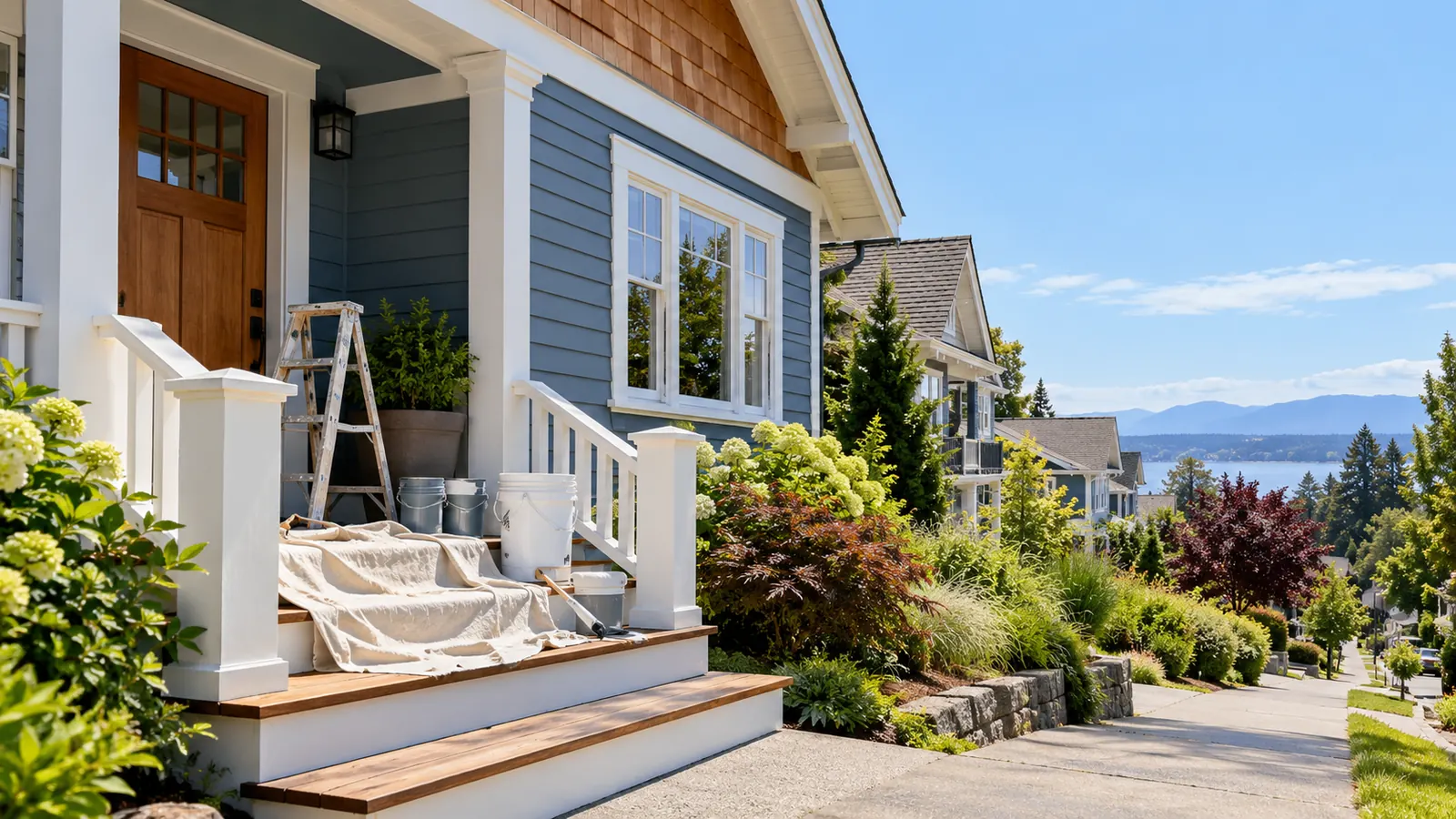
What the climate record says
NOAA’s 1991-2020 climate normals for the Everett Snohomish County Airport station at Paine Field show a sharp summer dip in rain. July averages 0.84 inches of precipitation and August 0.98 inches, with only about 2.3 and 2.5 days a month of 0.10 inches or more. November is the wettest month, at 4.97 inches over about 11.6 rainy days, and December and January are close behind.
| Month | Average high | Average low | Precipitation | Days with 0.10 in or more |
|---|---|---|---|---|
| May | 62.5 °F | 47.6 °F | 2.11 in | 6.5 |
| June | 66.4 °F | 51.4 °F | 1.89 in | 4.8 |
| July | 72.3 °F | 54.7 °F | 0.84 in | 2.3 |
| August | 73.0 °F | 55.4 °F | 0.98 in | 2.5 |
| September | 67.7 °F | 52.3 °F | 1.68 in | 4.8 |
| October | 57.7 °F | 46.0 °F | 3.35 in | 8.3 |
Those are averages over thirty years, not a forecast. Some Junes are dry and some Septembers wet. But the pattern explains why July and August are the safest months to plan around, and why the shoulder months of June and September work in some years and not others.
Dry wood matters more than a dry day
The U.S. Forest Products Laboratory’s Wood Handbook advises painting wood when its average moisture content is about what it will be in service, roughly 12% for most of the United States and Canada. If the moisture content is above 20% when the wood is painted, the risk of blistering and peeling increases. After a wet spring, siding can stay damp well after the rain stops, especially on shaded walls.
Ask your painter to check the siding with a moisture meter on each wall before starting. North walls and areas under trees often lag behind the sunny side.
Watch the dew
The Wood Handbook warns against painting late in the afternoon if heavy dew is expected overnight. Water absorbed into paint that has not finished curing can cause wrinkling, fading, loss of gloss and streaking. Dew forms first on parts of a house that cool quickly, such as eaves, soffits and porch ceilings. The handbook notes that the dew point is a good estimate of the nighttime low, so a forecast low close to the dew point is a warning sign.
A practical scheduling plan
- Get bids early so you can schedule the job for the driest stretch.
- Plan prep, such as washing and repairs, for late spring so the siding has time to dry before painting.
- Paint in the morning and early afternoon on days with a dry forecast for at least the next day.
- Leave the sunny south and west walls for midday, and shaded walls for the warmest, driest stretch.
- Keep a few rain days in the schedule; a short delay is cheaper than repainting.
Can you paint in spring or fall?
Sometimes. May and September have more rain than mid-summer but far less than winter, according to the NOAA normals. The deciding factors are the moisture in the wood, overnight dew and the forecast for the following days. A small job, such as one side of the house or the trim, is easier to fit into a short dry window than a whole house.
Why timing affects how long paint lasts
Paint applied to damp wood or interrupted by dew does not fail right away; it fails early. The Wood Handbook’s research on western redcedar also shows that bare wood left to weather before painting shortens paint life, so do not leave new siding or freshly scraped areas exposed for weeks waiting for perfect weather. Prime them promptly. More on this in How Long Exterior Paint Lasts in Washington, and What Makes It Last Longer and Painting in Pacific Northwest Weather: Rain, Dew, Damp Wood and How to Work Around Them.
Before you book
Temperature as well as rain
Everett summers are mild rather than hot. The NOAA normals put average July highs at 72.3 °F and lows at 54.7 °F, while May and October lows sit in the mid-40s. Cool nights mean dew, and dew is the main threat to fresh paint even on a dry day. Check the product label for its minimum application temperature, and remember the Wood Handbook’s point that dew forms first on parts of a house that cool rapidly, such as eaves, soffits and porch ceilings.
Use the wet months for planning. Get written bids, verify that the contractor is registered with Washington’s Department of Labor and Industries, and settle colors before the crew arrives. Our guides to How to Hire a House Painter in Everett: Registration, Bonds, Bids and Red Flags and Exterior Paint Prep Checklist for Everett Homes: From Washing to the Last Coat walk through each step.
How long will your paint or stain last? Try the paint life check.