
Before you start
- November averages almost 5 inches of rain at Paine Field.
- Dew forms first on eaves, soffits and porch ceilings.
- Unsealed end grain lets water into painted wood.
Paint does not mind rain once it has cured. What it minds is water getting into the wood behind it, or onto the film before it is dry. In a place as wet as Everett, a good paint job is mostly a plan for keeping water out at every stage: before, during and after painting.
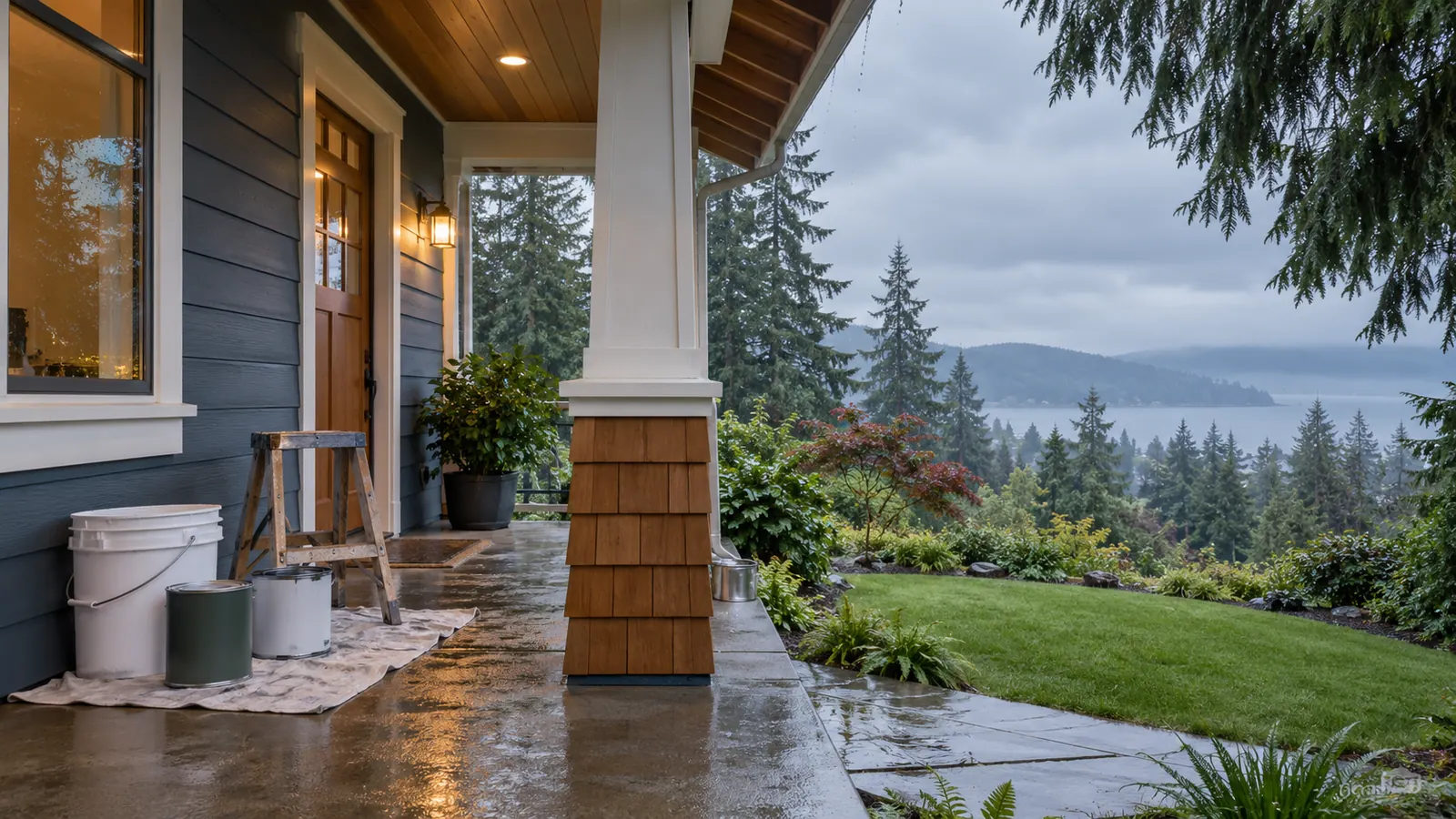
How wet is it, really?
NOAA’s climate normals for Paine Field show about 3.9 inches of rain in January, 3.6 in March and almost 5 inches in November, against less than an inch in July and August. The wet months bring rain on 11 or 12 days a month on average. Even in late spring, May still averages 2.11 inches over about six and a half rainy days.
Three ways water ruins a paint job
| Problem | What happens | How to avoid it |
|---|---|---|
| Painting damp wood | Above 20% moisture content, blistering and peeling risk increases | Let wood dry; check with a moisture meter |
| Dew on fresh paint | Wrinkling, fading, loss of gloss and streaking | Stop early on days with heavy dew forecast |
| Water through end grain and joints | Raises moisture behind the paint and can draw extractives to the surface | Seal end grain; keep caulked joints sound |
Each of these comes from the U.S. Forest Products Laboratory’s Wood Handbook, the federal reference on how wood and finishes behave. It notes that unsealed end grain increases the moisture content of painted wood, and that water from rain and dew entering a thin paint coat or open joints can carry extractives from woods like western redcedar to the surface as stains.
Protect the ends and edges
End grain soaks up water far faster than the face of a board. The Wood Handbook recommends painting all end grain with an oil-alkyd primer where possible, including the ends of siding and trim, brick molding, railings, posts and the edges of panel products. When siding meets a sloping roof, it calls for a 2-inch gap between the end grain of the siding and the roof shingles so the boards do not sit in water.
Tip: Look closely at the bottoms of porch posts, trim boards near the ground and siding that butts into the roof. These are the first places water gets in and paint lets go.
Sheltered areas behave differently
Areas protected from sun and rain, such as porches, soffits and walls under deep overhangs, tend to collect dirt that reduces the adhesion of new paint, the Wood Handbook says. Wash them before repainting. It adds that repainting these protected areas every other time the rest of the house is painted usually performs well enough.
Mildew and algae
Damp climates grow mildew. The handbook calls mildew the most common biological problem on painted wood; it does not degrade the wood, but it causes gray or black blotches, and algae, usually green, often grows with it. Clean it before painting, never paint over it. See Mildew, Algae and Moss: How to Clean Siding Before You Paint in the Northwest.
Working with the season
- Schedule painting for July and August when you can; see The Best Time to Paint a House in Everett: Reading the Calendar and the Siding.
- Do washing, scraping and wood repairs early, then let the house dry.
- Prime bare wood quickly; do not leave it exposed for weeks.
- Watch the dew point and overnight lows, not just the rain forecast.
After the crew leaves
Full-year rain at Paine Field
| Month | Precipitation | Days with 0.10 in or more |
|---|---|---|
| January | 3.89 in | 11.2 |
| February | 2.84 in | 9.5 |
| March | 3.63 in | 11.2 |
| April | 2.67 in | 7.7 |
| May | 2.11 in | 6.5 |
| June | 1.89 in | 4.8 |
| July | 0.84 in | 2.3 |
| August | 0.98 in | 2.5 |
| September | 1.68 in | 4.8 |
| October | 3.35 in | 8.3 |
| November | 4.97 in | 11.6 |
| December | 4.52 in | 11.6 |
These are NOAA’s 1991-2020 normals for the Everett Snohomish County Airport station. The pattern is plain: two dry months, two shoulder months and a long wet season, with the wettest stretch from November through January.
Paint also needs time after the last coat. Plan the final coat for the start of a dry stretch, not the end, so that rain and dew do not reach it before it cures. If a shower does catch fresh paint, let it dry and inspect the next day; the Wood Handbook lists streaking, loss of gloss and wrinkling as signs of water on uncured paint.
A wet climate also means maintenance. The Wood Handbook advises washing sound paint that has mildew rather than repainting it, and warns that repainting too often builds up a thick film that can crack. Walk around the house each spring, wash what needs washing and touch up any spots where water is getting in. More in How Long Exterior Paint Lasts in Washington, and What Makes It Last Longer.
How long will your paint or stain last? Try the paint life check.