
Before you start
- Decks are usually finished with penetrating clear finishes or semitransparent stains.
- Solid-color stains should not be used on decks unless made for them; they tend to peel.
- Paint on railings can trap water if end grain is not sealed.
Decks and fences have the hardest job of any wood around the house. They are horizontal or fully exposed, they take foot traffic or ground contact, and in Everett they spend months wet. The finish that works on siding often fails on a deck. Here is what the U.S. Forest Products Laboratory’s Wood Handbook recommends.
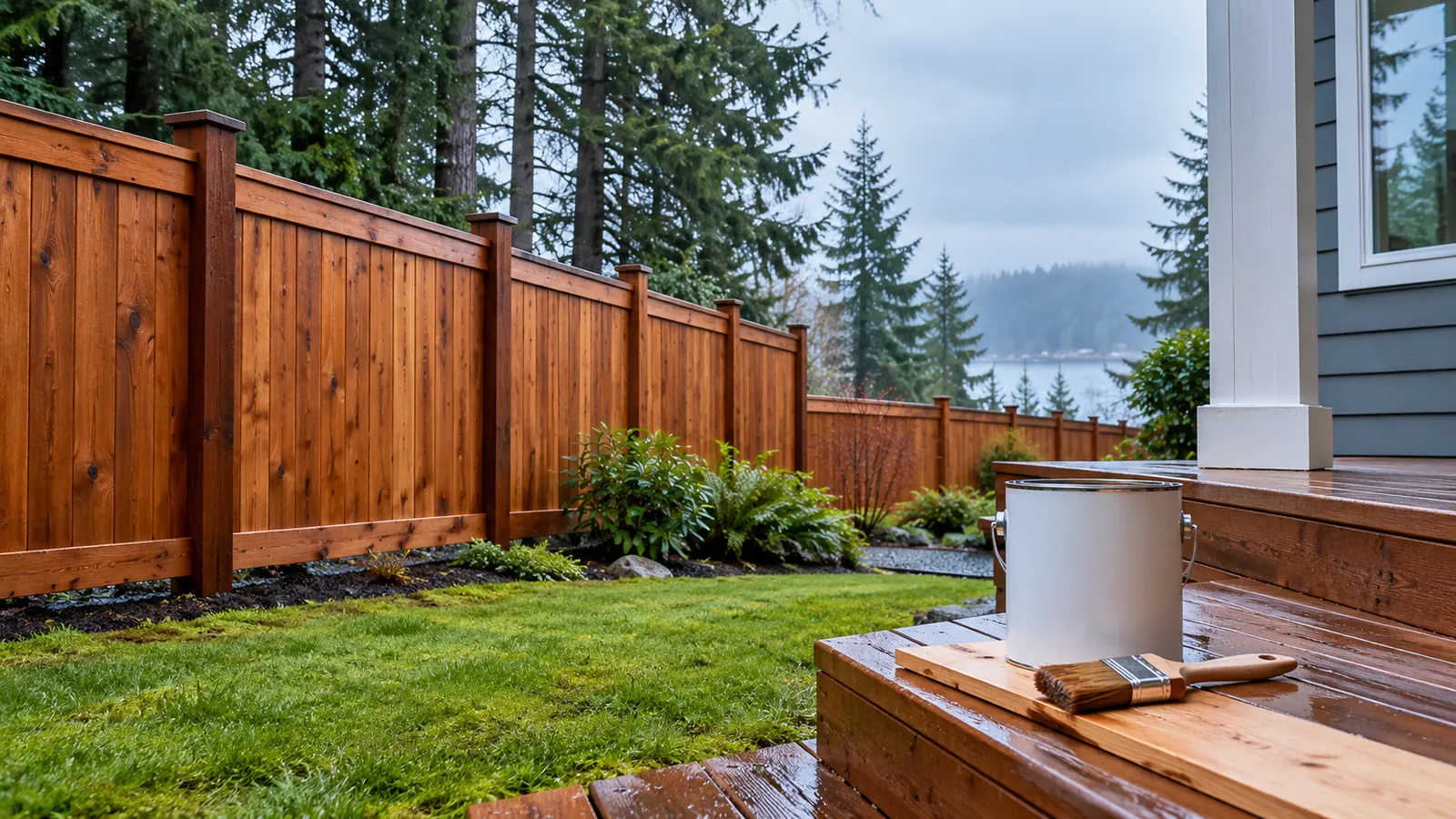
Decks: penetrating finishes, not film
The Wood Handbook says decks are usually finished with penetrating clear finishes, lightly pigmented clears or semitransparent stains. These need applying more often than paint, but they need little surface preparation because they seldom fail by cracking and peeling. Unless a product is specially formulated for decks, the handbook advises against solid-color stains on decks and porches, because they lack abrasion resistance and tend to peel.
| Finish | Typical life | Notes |
|---|---|---|
| Water-repellent preservative | 1 to 3 years | Keeps wood from soaking up water; little color |
| Tinted clear finish | 2 to 3 years | Slight color, grain fully visible |
| Semitransparent stain | 4 to 8 years on siding; less on horizontal surfaces | Apply only what the wood will absorb |
| Deck-rated porch paint | Varies | Formulated to resist abrasion on porch floors |
The service-life figures in the handbook are for vertical surfaces. Decks face the sky and take traffic, so expect to recoat them more often.
Tip: Brush semitransparent stain on decks. The handbook notes that rollers and sprayers can put too much stain on horizontal surfaces.
Porches
Porches get wet from wind-driven rain. The handbook recommends a water-repellent preservative or primer on the end grain of flooring, railings, posts and balusters before or during construction, and notes that primers and top-coats for porch floors are formulated to resist abrasion.
Railings and end grain
End grain is the weak point. Film finishes such as paint on fences and railings can trap moisture if the end grain is not sealed during construction. The handbook illustrates a railing eight years after it was built, where water flowed down and soaked into the end grain while the paint kept the wood from drying out. If railings are painted, seal the end grain or use pressure-treated wood, particularly where decay would be a safety hazard.
Fences
Fences are fully exposed and their posts touch the ground, so decay and insects are real risks. The handbook recommends lumber pressure-treated with preservatives, or naturally durable species, for posts and any part in ground contact. Freshly treated wood should dry before finishing; the handbook suggests about a week. Wood treated with coal-tar creosote or other dark oily preservatives is not paintable except with special finishes.
Cleaning before refinishing
- Test dark areas with a drop of bleach to identify mildew.
- Clean with a dilute bleach, water and powdered detergent solution; see Mildew, Algae and Moss: How to Clean Siding Before You Paint in the Northwest.
- Use low pressure if power washing to avoid damaging the wood.
- Probe soft areas, especially post bottoms, and replace decayed boards.
When to do it
Penetrating stains need dry wood that can absorb them. Everett’s driest months are July and August, according to NOAA’s climate normals; see The Best Time to Paint a House in Everett: Reading the Calendar and the Siding. Avoid finishing late in the day if heavy dew is expected.
Weathered wood
Bare wood weathers quickly outdoors. The Wood Handbook explains that the surface changes chemically within a few weeks and that sunlight degrades the surface layer. Badly weathered wood with loose fibers on the surface does not hold a new finish well, so scrub or lightly sand it before applying stain. Penetrating stains such as semitransparent stains are more forgiving on weathered wood than film-forming paint, which is one reason they are the usual choice for decks.
Keep it simple to maintain
Pick a finish you are willing to renew on schedule. A penetrating stain on a deck needs recoating every few years, but the work is mostly cleaning and brushing on a coat. A painted deck lasts longer between coats but, when it fails, has to be scraped and primed. In a wet climate, the easier job that actually gets done is often the better choice.
Finally, plan for the parts you cannot easily reach later. Before boards go down or rails go up, seal cut ends and the tops of posts, the handbook advises, because once the structure is built those end-grain surfaces are where water gets in and where paint and stain fail first. On an existing deck, check the tops of posts and the ends of boards each spring and reseal any that look gray or soft.
Leftover stain and paint can go to a PaintCare drop-off site in Washington at no charge, as long as containers have lids and labels.
If the deck or fence is on an older property, check for lead paint before scraping old coatings; see Painting an Older Everett Home: Lead-Safe Rules, Prep and What to Ask a Painter.
How long will your paint or stain last? Try the paint life check.